Bulgaria September 2023

I’m not sure there’s a word that fully describes or captures the thinking behind visiting a country purely to visit one building. Maybe niched, eccentric even. Focused if we are being kind, obsessive and compulsive if we are not. I mean, it’s not normal is it? People will of course see the Eiffel Tower as a central part of visiting Paris but would they go to France if Mr Eiffel had put his tower in a field somewhere in the middle of nowhere and the rest of Paris didn’t exist?
And to be fair to myself I didn’t actually organise a trip purely to visit one building, because that would be silly. What I actually did was decide to visit a country purely to visit one building and then looked for lots of reasons to justify going. Which of course is totally different.
Fortunately, because the country in question is Bulgaria and specifically the gorgeous central Balkan Mountains, it was far from difficult to build a road trip consisting of so many beautiful and fascinating stops. And the building at the centre of it all? Well, that is The Monument House of the Bulgarian Communist Party, otherwise known as the Buzludzha monument.

But more on that later.
Our journey starts in the small town of Karlovo. Although meant as a mere stopover on the way to our real ‘first’ destination it becomes an unexpected delight that is a signal for so much that we would come to experience in Bulgaria. Positioned on one of the straight east-west roads that connect Sofia to (ultimately) the coast, it is dominated by the Balkan Mountains on one side and alternating wide flat plains and gently rolling hills on the other. As with other settlements along this road Karlovo wears its history on its sleeve, the whole place a monument to different stages of history that appear to have evolved alongside rather than eliminating what came before. It is utterly charming and provides the best restaurant of our trip and the one where we learnt the very hard to pronounce Bulgarian word for thank you is not even used, the wise locals instead preferring the French ‘merci’. It is also the location for a battle of wills between the patient staff and the street dog who keeps wandering into our picturesque courtyard. Hilariously, once all other routes have been blockaded the ambitious mutt thinks he’s found a discreet way in, not realising that ground level spot lamps are projecting his ten foot shadow onto the rear wall. A lost battle maybe but his perfect figure and content demeanour suggests he is not losing the war.


For our onward journey we actually have to backtrack for a while before striking north through the only road that bisects the mountains at this part of the national park. The twisting hairpins are no surprise as these hills are major skiing centres in wintertime but our journey to the top is interrupted only by a brief stop to say hello to a genial Frenchman who sleeps in his van and spends the day paragliding off the side of these slopes and into the warm Autumn air. A man who is clearly living his life and not just because he can say thank you so adequately to the locals.


At the peak we are greeted by that most East European of sites, a nationalist monument. Few parts of the world do this better and the Arch of Freedom would be impressive in any setting, but sitting astride these mountains, seemingly guarding and protecting all approaches, it is a mighty sight. The vast arch celebrates twin liberations, from the Ottomans in the late 19th Century and Nazi Germany six and a half decades later. The liberators in both cases were Russians or Russian led, which is maybe ironic given the events of the post-war period.


Now with gravity behind us we descend quickly and turn east through more gently hilly countryside towards Veliko Tarnovo.
Veliko Tarnovo is a remarkable city. Built as it is on a series of hills and ridges it has an imposing and dominant feel and indeed has a history as a strategically vital defensive fortress. Our tiny flat is situated on one such ridge and looks out over the gully below towards the castle which sits on the far side. The walk between the two takes in the town centre which is buzzy without being touristy busy and takes in decent bars, restaurants, cafes and a nascent arts scene.


Again the history is all there in the raw and such is the ancient, windy and narrow road where our accommodation sits that we need to transport our luggage a couple of hundred metres from the nearest parking. Make no mistake though, a wheelie suitcase is a match for anything bigger and faster on such roads. Day one is an urbex dream, a downhill hike taking us to a quiet riverside walk and the delights of a Soviet era abandoned textile factory that retains some fantastic murals and just enough detail to remain an evocative reminder of former days.


Another stark reminder of Soviet times amongst the otherwise ancient town comes with the 1960s brutalism of the Interhotel. Once a status symbol for the elite and well connected, it subsequently fell into complete disrepair. Now it is in a strange in-between place, still largely empty and desolate but being slowly renovated enough for active building work to be done and for us to have a very pleasant terrace lunch at the newly opened cafe bar.
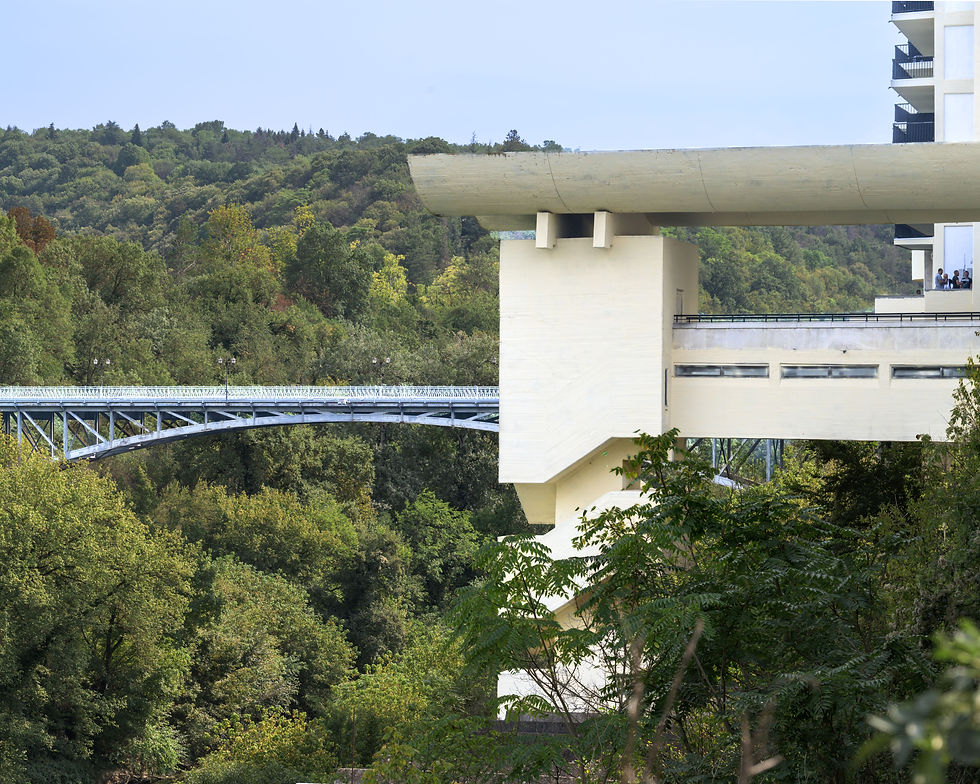

Whatever the delights of the town - and there are plenty including museums, churches and numerous quirky bits of old architecture before you even get to the castle itself - the eye is always drawn back to steep drops into the wide valley and the views beyond. This changes personality regularly throughout our stay, the view able to transform from early morning sunshine and mist at breakfast to a mid-afternoon coffee admiring the far wooded slopes bathing in sunshine. The biggest surprise is still to come though. We are told about a laser show over the castle once the sun goes down and advised on some of the best venues to view it from. Not fancying the queues or crowds we instead invest in a takeaway and bottle of wine on our little (but increasingly appreciated) balcony and discover what feels like a private viewing of the most beautiful sound and light display. This is far from a mere tourist attraction and moves beyond admittedly impressive aesthetics to keep the town’s history alive with a vivid storytelling of the town’s story through the ages.

It is with genuine regret that we leave this fascinating town but it is a road trip after all, and we have ahead of us the longest drive of the trip and an opportunity to visit Plovdiv, regarded by many as a real jewel in the Bulgarian crown.
On the way though we have something very different to see first, in fact the original and driving purpose of the whole trip. The Buzludzha Monument, quite literally, looms ahead of us.

Again, the journey is on winding, twisty roads through increasingly hilly country. In hindsight, we approached from the ‘wrong’ side and had a longer but far more secluded approach. Towards the peak of the mountain range we encounter a truly beautiful moment, one of those that is hard to describe but where everything momentarily stands still. We stop the car and get out as the trees become denser and find ourselves in the freshest mountain air with just the right amount of breeze. A light mist sits across the road and slips into the undergrowth either side of us, this and the shadows punctuated by strands of light cutting down between the trees. A borderline mystical experience and one that is accentuated when we travel a mile or so further and catch our first glimpse of the Buzludzha.

Conceived in the late 50s and not finished until 1981 this huge UFO shaped building was built to commemorate, naturally in Bulgaria, heroic nationalist victories in both the 19th century and World War II as well as the birthplace of the Bulgarian socialist movement. In addition to humungous amounts of concrete its construction literally involved the lowering of the mountain. The main building (there are other monuments on the broader site) was built in maybe peak modernist, brutal style with a spectacular array of mosaics depicting the glories of Bulgarian history or communism. The main tower sits above and to the side, huge red stars gazing down and across the distant peaks and valleys.
Used as a museum and ceremonial venue this huge undertaking was only open until 1989 and the fall of the communist state. Thereafter followed a long period of disuse and appropriation or theft of many of the materials and valuables used to originally build and decorate it. Locked from the early 90s many visitors whether explorers or thieves still gained access, an activity that became increasingly difficult and probably dangerous. Even if there is still a way in through a ventilation shaft there is usually a security guard on site.
Nonetheless, despite being stripped of so much of its glory it remains a formidable and evocative place, a feat which so much Soviet architecture manages to achieve. It may smack of hubris for sure and a glorification of statism, but symbols matter a lot in countries that have struggled so hard for identity and independence through history. In its proud decay it retains its magnificence.


Onwards we drive, a series of small towns and villages punctuating our journey south. Amongst the usual historical mishmash of architecture we also meet any number of resourceful street dogs, the most resourceful of which act like Dickensian street gangs, raiding momentarily neglected lunch boxes before swiftly retreating in multiple directions, sometimes snatching lumps of bread from each others mouths.
We also see more of a phenomenon we have witnessed throughout our trip. Throughout we see nekrósimo, or necrologs. Death is a communal affair in Bulgaria and people post notifications of the deaths of their loved ones in public places. Starting as a notification and focal point for shared grieving, the notices remain and are updated over time and collectively form a quite beautiful and very moving piece of social history.
Plovdiv does not disappoint.
Its reputation is as a scientific and cultural centre, one that is enhanced by a top-class University. The French influence is strong in Bulgaria (not just in how they say ‘thank you’) which is curious at first but explained by their search for cultural inspiration in the late 19th Century after winning independence from the Ottoman Empire. This is manifest in our accommodation, an apartment on a tree-lined street with intricate ironwork on the balconies of multi-story townhouses. Honestly, we could have been in a 19th Century Paris neighbourhood.


Plovdiv is famous for a whole range of beautiful architecture including a Roman-era theatre, but it is actually a disused football stadium that first captures our eye. A massive scoreboard and display is evocative to me of 1970s European football and it overlooks crumbling stands and terraces. Tubular steel walkways allow access to the upper tiers and monstrous floodlights loom over the whole structure. Everything is crumbling beyond one small section that is the legacy of an ultimately futile attempt at full regeneration. In a place that would be completely sealed off in the West they keep the pitch and running track in top condition and these are being used as practice by various athletes while we pick our way through the decay above. History is not just about museums and other controlled environments, here you feel it in every step.

The Pantheon Bratska Mogila, or Monument to Brotherhood, is nearby and is disappointingly closed due to disrepair.This seems a surprise as well as a shame given that it celebrates those who fought for the country and actually contains interred human remains. It is for this reason we do not take advantage of the very obvious urbex entry to the interior but the open design reveals a good sight and understanding of a place that really deserves more love.


The ancient city is as gorgeous as you would expect, with the still functioning Roman amphitheatre providing performances with a view to kill over distant mountains. We find more informal entertainment in the form of the park that snakes its way up Bunarjik Hill. At the top is a mammoth plinth and statue of a WW2 soviet soldier. This dominating and militaristic behemoth is somewhat controversial and there is an ongoing debate about its possible removal. In the meantime the people of Plovdiv show that life moves on in the best possible way and use the pleasant autumn evening to play music, dance, sing, date or just hang out.
Inevitably we are drawn away from the beauty of ancient remains and towards the former and now dilapidated industrial sector of the city. Plovdiv was at the heart of the regional tobacco trade and Tobacco City is the legacy of this. The warehouses where the product was stored are often now in a state of semi-ruin and the smart townhouses where their owners lived still seem inhabited but are showing their age. Controversy surrounds the redevelopment of the areas as competing interests clash, but for now there are still plenty of examples of crumbling yet evocative industrial heritage.


If this all sounds like breathless stuff it’s only a reflection of the Plovdiv. With pretty well everything only a brisk walk away it is an urban area of delight after delight, like a historical and social smorgasbord laid out in front of the visitor while never feeling like a museum or artefact. There is just one more place to describe and that is the main post office. In fact, it is also a timely reminder that it is always worth a peak inside soviet era municipal buildings. Even if, like this one, they are not tremendously exciting on the outside (this one is brutalist but not particularly exciting) delights can still be found on the inside.
In this case it really does feel like time travel as you walk into a perfectly preserved example of the status soviet governments attached to public buildings. It is both quite beautiful and of its time, brutalist in nature yes but with carefully crafted signage and woodwork alongside large interior gardens. It is a complete delight and I make a mental note to always go into soviet era public buildings and especially post offices and train stations.


We make our way to Sofia for a final afternoon and evening stroll. It strikes us as a very lovely city but in truth our hearts and minds are still in the Central Balkans mountains and surrounding areas. Maybe one for another time, for now we can absorb ourselves into an adventure of so much depth and so many levels, yet one that started with the quest for that individual building.


Comments